The W-Cube nanosatellite, made in Finland and ordered by the European Space Agency ESA, is currently descending towards the atmosphere at the end of its successful mission. Along with the satellite, its VTT-made radio beacon system will also ignite and burn to dust. The mission demonstrated for the first time ever that the extremely high and fast 75 GHz frequency band can be used in future telecommunications satellites.
The European Space Agency's (ESA) W-Cube satellite is currently rapidly dropping its flight altitude at around 200 kilometres above the Earth's surface. Scientists expect that the connection will be lost anytime soon as atmospheric friction increases, causing the satellite to ignite and be destroyed in the atmosphere. This is expected to happen within few days.
"This marks the end of a very successful space mission that has been fascinating to be a part of. The W-Cube satellite validated that much higher frequency bands than those used today can be utilised in satellite communications and achieve very high performance. This opens possibilities for bringing faster data connections to consumers in Europe as well—even directly to their smartphones," says Jussi Säily, Principal Scientist at VTT and Project Manager.
He points out that societies are dependent on functioning telecommunications. Satellite-based connections are more difficult to disrupt than terrestrial ones. Also, decision-makers in the EU have also realised that the United States may limit satellite connections it controls at will, which motivates the development of real European alternatives.
Ultra-high radio frequencies provide valuable benefits: many more high-speed and yet non-reserved frequency bands will become available. The rapid development of semiconductor technology enables commercial applications of millimetre wave technology with good efficiency. In satellites, this is important as it reduces power consumption.
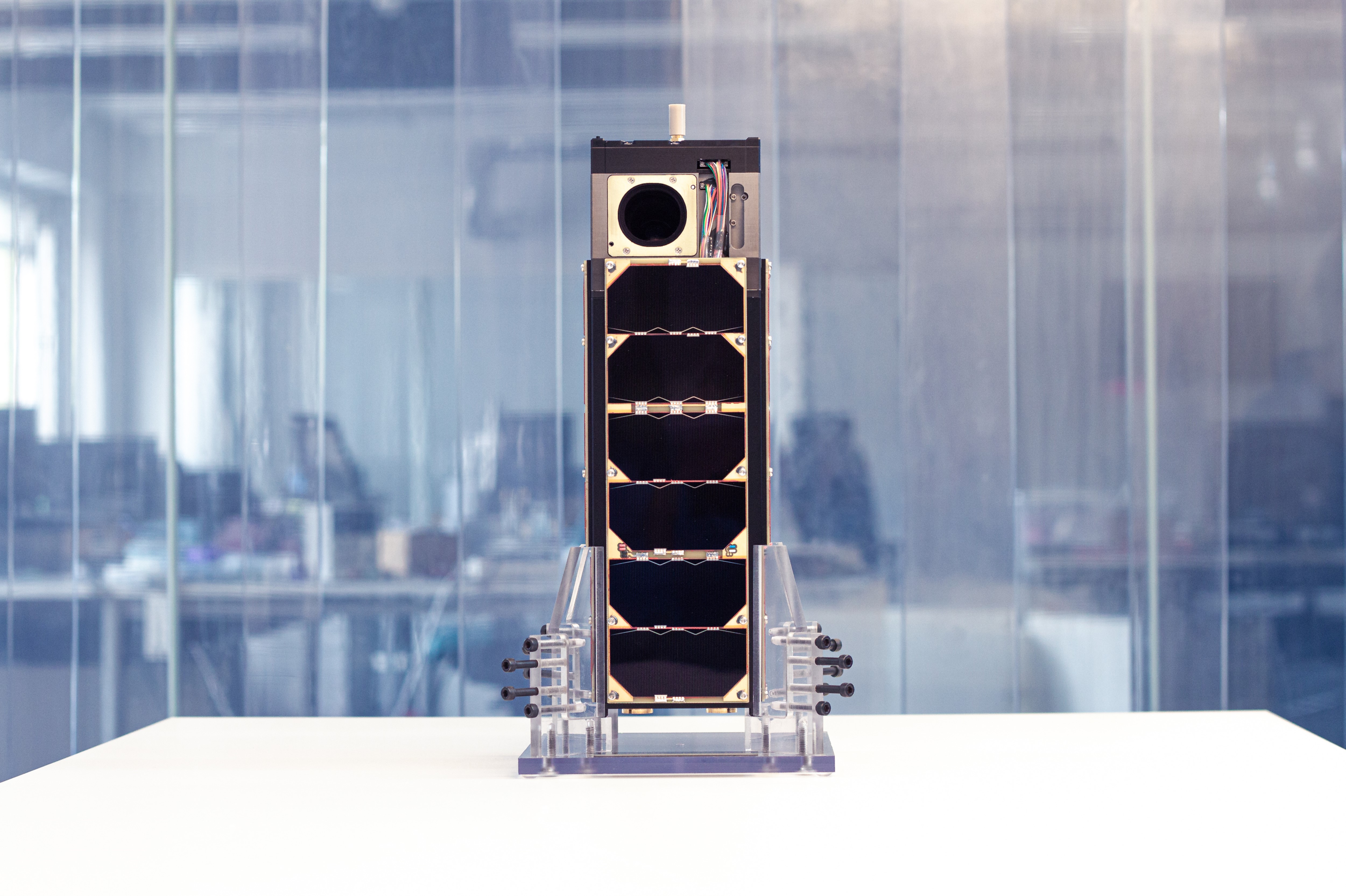
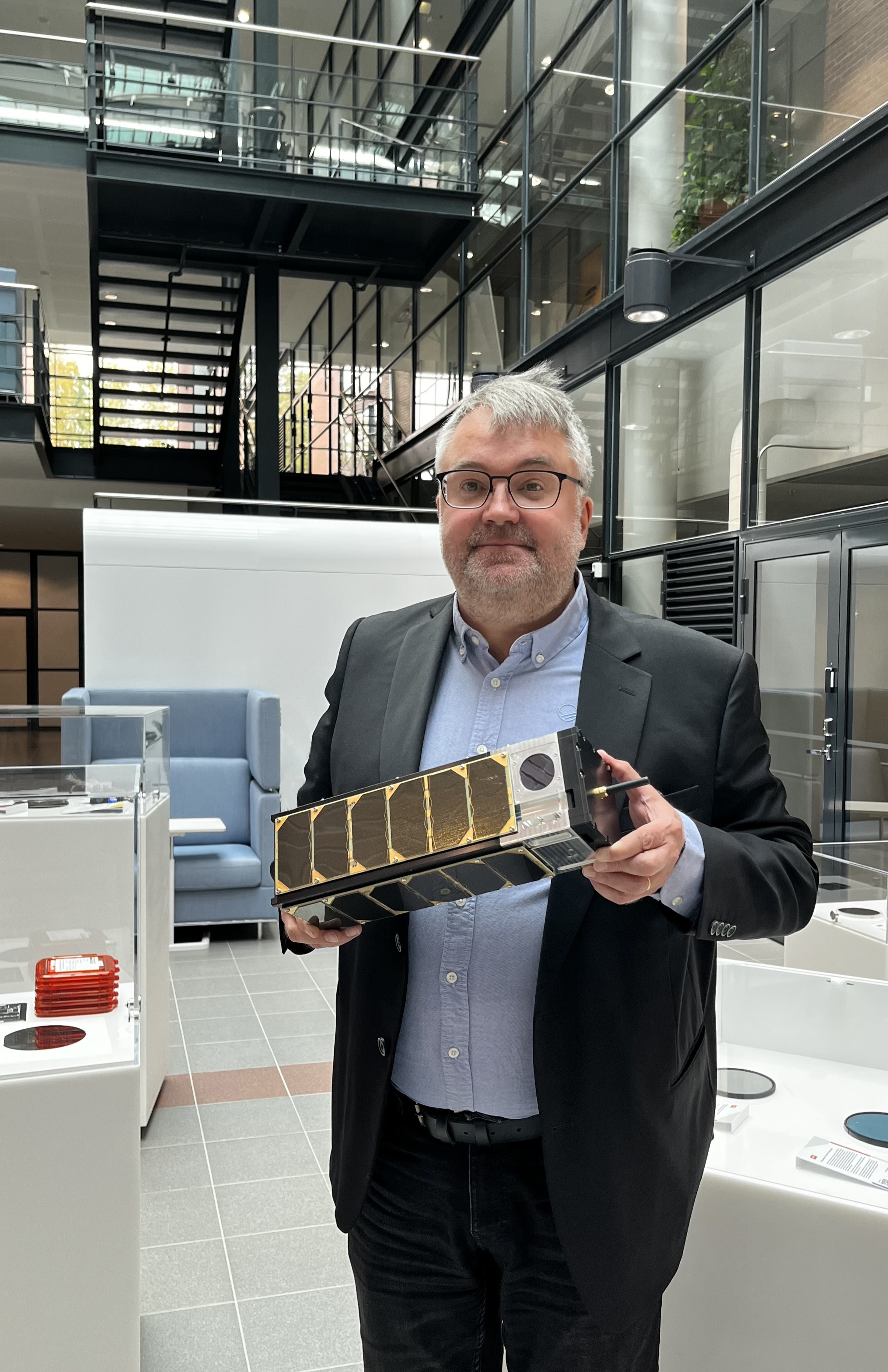
The size equals a milk carton of one and a half litres
W-Cube was the first satellite ordered from Finland by the European Space Agency (ESA). The satellite—only slightly larger than a one-and-a-half-litre milk carton—was launched into orbit on 30 June 2021. It transmitted the radio signals essential in the mission using a radio beacon system developed by VTT Technical Research Centre of Finland and the German Fraunhofer IAF.
The reliably functioning satellite platform of the Finnish company Kuva Space also played an important role. It consists of a frame, an attitude control system and solar panels, among other things. From its own ground station, the company was also responsible for operations.
"Thanks to our experience with W-Cube, we have developed our systems so that satellite operations are fully automated. We have now launched five nanosatellites and achieved a 100% success rate that many others have not been able to match," says Janne Kuhno, Chief Engineer and founding partner of Kuva Space.
For Finland, the value of the W-Cube basic project was approximately one million euros, of which VTT's share was about half. VTT built and tested the payload and mechanics, such as the control electronics, frequency synthesizer and antennas.
The purpose of the W-Cube satellite was to find out how much the Earth's atmosphere and its phenomena, especially raindrops and rain clouds, attenuate a very high-frequency radio signal. No previous experience of this existed. Signal reception was successful at ground stations in Finland, Austria and the Netherlands.
"At our own satellite ground station in Otaniemi, we have been able to receive the signal until the very last few days. Based on long-term measurements carried out in different climate conditions, we have been able to create attenuation models that are absolutely essential when designing and dimensioning future high-speed telecommunications satellites," Säily says.
The W-Cube's four-year operating time is a good achievement for its size class. Nanosatellites have a maximum lifespan of five to six years.
VTT was already invited for the next project with ESA
VTT has made several publications on the modelling together with the Austrian Joanneum Research. ESA has been very satisfied with the results.
"W-Cube has brought good reputation to VTT, and I’m already leading the next, larger project, with the aim of launching a significantly bigger 6G-Lino satellite next year, also commissioned by ESA," says Jussi Säily. For him, W-Cube was the first satellite project, but he has long led e.g. 6G research and other mobile network projects at VTT.
The use of high so-called millimetre frequencies in satellites also requires more accurate and long-term modelling measurements. This requires a geostationary satellite that remains stationary at 36,000 kilometres from Earth. The W-Cube only transmitted an unmodulated carrier wave at two different frequencies (37.5 and 75 GHz).
Before the frequency bands tested in the project can be used in commercial telecommunications satellites, they must also be tested with real, modulated telecommunications signals that contain information such as audio and video.
VTT's ground station to be further used in drone testing
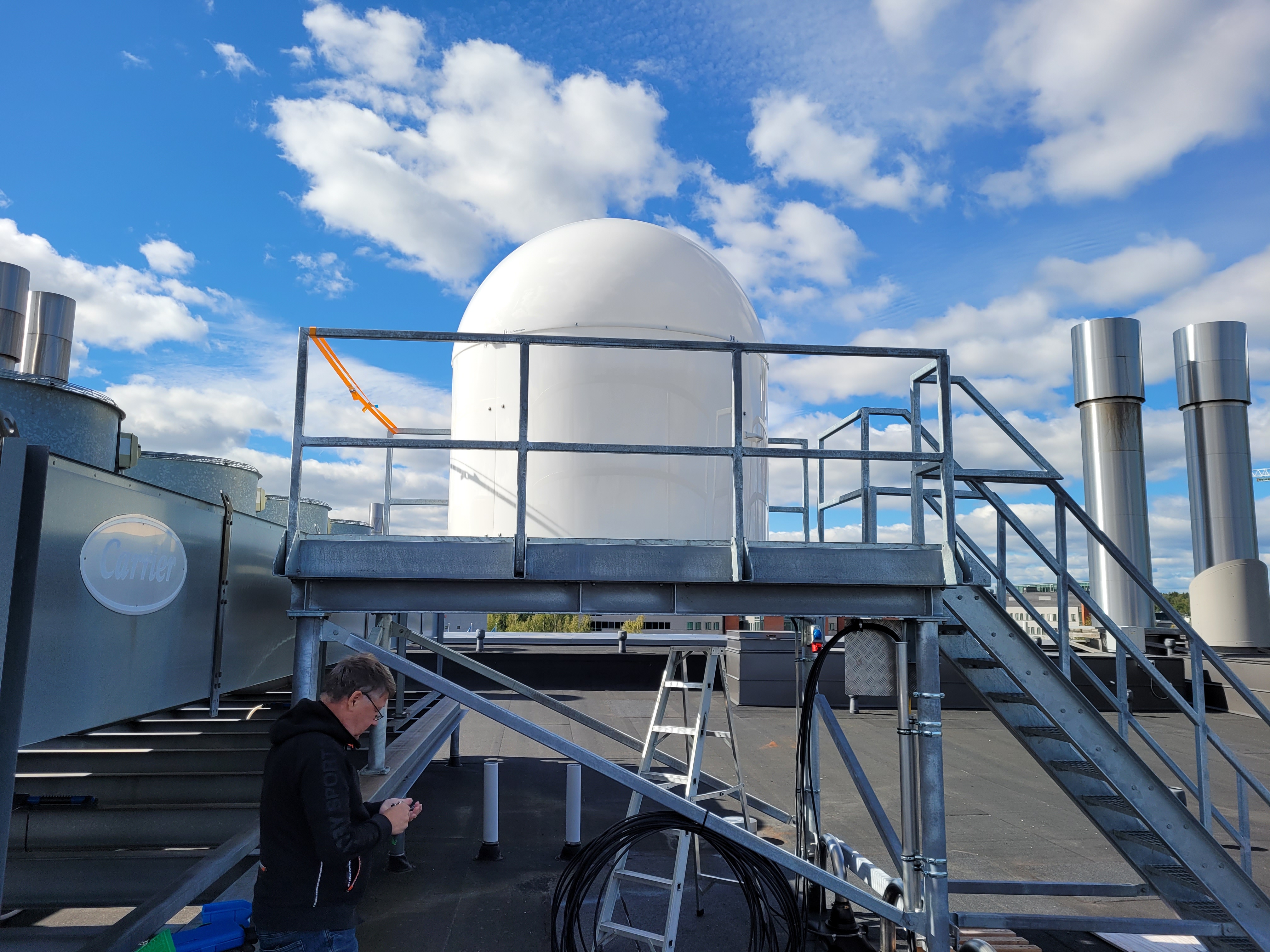
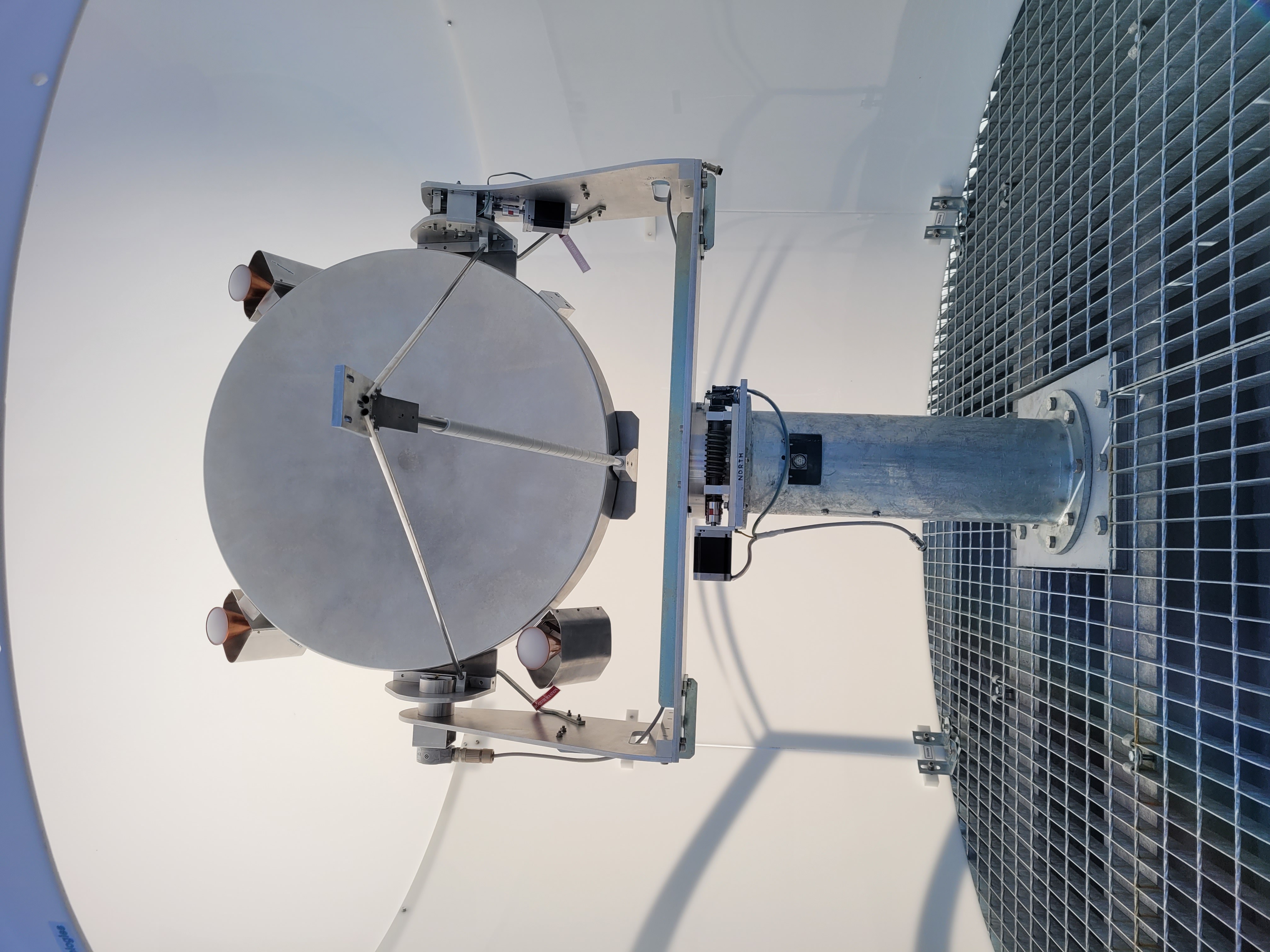
VTT's satellite ground station, commissioned in 2024, is located on the roof of the Micronova building in Otaniemi, Espoo. Its use will likely continue in further projects, and preparations to receive the signal from ESA’s geostationary Alphasat satellite beacon are already underway. Alphasat was launched already in 2013. The lower frequency range of its beacon signal on the so-called Q-band requires changes in the ground station’s receiver.
The ground station that turns quickly and follows the target can be used for other purposes as well. Its speed is illustrated by the fact that a nanosatellite is visible to a ground station for a maximum of ten minutes as it flies from horizon to horizon. Another area of potential future use of the ground station is testing drones and the use of millimetre frequencies in their data communications.
W-Cube Satellite
- Size of three Cubesat units, or 3U. One Cubesat unit is approximately 10 x 10 x 10 cm.
- Design, construction and testing phase 2018–2021. Launch 30.6.2021.
- Operational phase until mid-September 2025.
- A radio beacon based on VTT's state-of-the-art technology.
- Validated that the new frequency bands in the so-called E-band (71–86 GHz) and W-band (75–110 GHz) can be utilised in satellite communications.
Website following the journey of the W-Cube nanosatellite: https://www.satcat.com/sats/48965

Continue reading
Service:
Space technology
White paper:
Through the Valley of Death – How can Finland grow?
Share