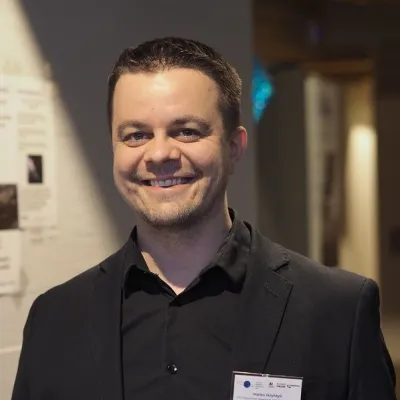
Reliable telecommunications are a critical part of daily services and security. Satellite communications have become one of the key areas of the development in future telecommunications networks. VTT is strengthening its excellence in this area with Marko Höyhtyä beginning work as Research Professor in satellite communications. His work focuses on the development of technologies related to communication and space systems to achieve a unified network that remains reliable in challenging environments.
Our everyday life relies on critical functions, such as official activities in remote areas as well as data centres and other infrastructure solutions. Reliable communications with wide coverage ensure that our everyday life remains free of disruptions. Communications play an important role in other aspects of everyday life as well – those where communications are vital for security and defence.
A single communication system is insufficient in situations where disruptions or interruptions are expected. Consequently, communications increasingly consist of a multi-layered solution with complementary satellite, aerial and terrestrial networks.
“If one connection is weakened or interrupted, data can be transferred along a different route. A multi-layered design improves the reliability of communications across various conditions and maintains connections in exceptional circumstances,” Höyhtyä states.
Multi-layer networks and role of satellites
Terrestrial networks are and will remain the backbone of communications. A multi-layer, dynamic communication network consists of multiple layers. Terrestrial networks form its foundation, with fixed and mobile ground stations responsible for the management of connections and the interconnection of the different layers. Higher up is the aerial layer, consisting of uncrewed aircraft and aeroplanes for fast data transfer and monitoring.
These are complemented by satellites that provide global coverage and ensure connections in remote areas. LEO satellites in the 500–1,000 km Low Earth Orbit fly at high speeds close to Earth, while GEO satellites, at 36,000 km altitude in Geostationary Earth Orbit, remain stationary relative to Earth.
These different satellite layers offer different advantages for communication and positioning systems.
“Low-orbit LEO satellites enable fast connections and high performance, including for mobile solutions. This is due to terminals that can be used on vehicles and other platforms with an uninterrupted connection when the serving satellite changes. On the other hand, GEO satellites in higher orbit offer stable and wide-coverage connections, and their communication signals remain reliable even during GNSS interference. These systems complement each other and reinforce the reliability of communications in circumstances where a single solution is insufficient,” Höyhtyä says.
In the future, LEO satellites may provide positioning and timing signals for critical systems and improve resilience against interference.
“If these technological development paths can be integrated in 6G systems, standardised and reliable connections can be a global reality in the 2030s,” Höyhtyä states.
Development driven by defence and uncrewed systems
Uncrewed systems and satellite networks have emerged as the most pressing topics in defence. The need for multi-layer networks becomes particularly critical in changing security environments and when connections are required under any circumstances. Satellite systems are more important for defence than ever.
“Strengthening satellite systems for security and defence solutions has become a key issue. Interference-resilient and difficult-to-detect communications are issues for which solutions are being developed as we speak,” Höyhtyä states.
Modern armed forces are reliant on communication satellites. The defence sector increasingly relies on commercial satellite services as those offer cost-effective, flexible and immediate access to the latest technologies – characteristics that traditional military systems are unable to provide as quickly.
“Satellite connections have revolutionised military operations: for example, they are used for situational awareness, transmitting artillery fire orders, controlling uncrewed aerial and naval vehicles, and securing civilian communications in crises. Data security has become crucial as well. Traditional geostationary satellites and many critical systems are vulnerable to interference and cyber attacks, and therefore military solutions must be technologically advanced as well as protected against electronic warfare and data breaches,” says Höyhtyä.
Growing space economy highlights expert shortage
The space economy is growing rapidly: its value is estimated to reach USD 1.8 trillion by 2035.
“Commercial satellite operations have grown extremely quickly: 4,500 satellites have been launched in 2025. A total of 15,000 satellites orbit our planet, the majority of which are communications satellites. Besides driving technological development, satellites hold great economic potential as well. The space economy will be one of the fast-growing sectors of the future,” says Höyhtyä.
Finland has the opportunity to become a future leader in developing solutions for extensive telecommunications expertise and official networks, the manufacture of space technology and satellites, and data analytics that serve both the civilian and defence sectors.
However, this growth requires experts – of whom there is a shortage.
“Many Finnish companies are looking to recruit international experts as the number of Finnish professionals in the field insufficient. More educational paths and research cooperation is required to drive these competences in Finland. The sector combines several areas of technology, such as telecommunications, signal processing, electronics, software development, mechanical engineering, data analysis, physics, material science and testing. In addition, there is a need for commercial expertise as well as manufacturing and legal professionals. The sector offers broad opportunities, and we welcome experts from highly diverse different backgrounds,” emphasises Höyhtyä.
Continue reading
Service:
Beyond 5G and 6G networks
Share