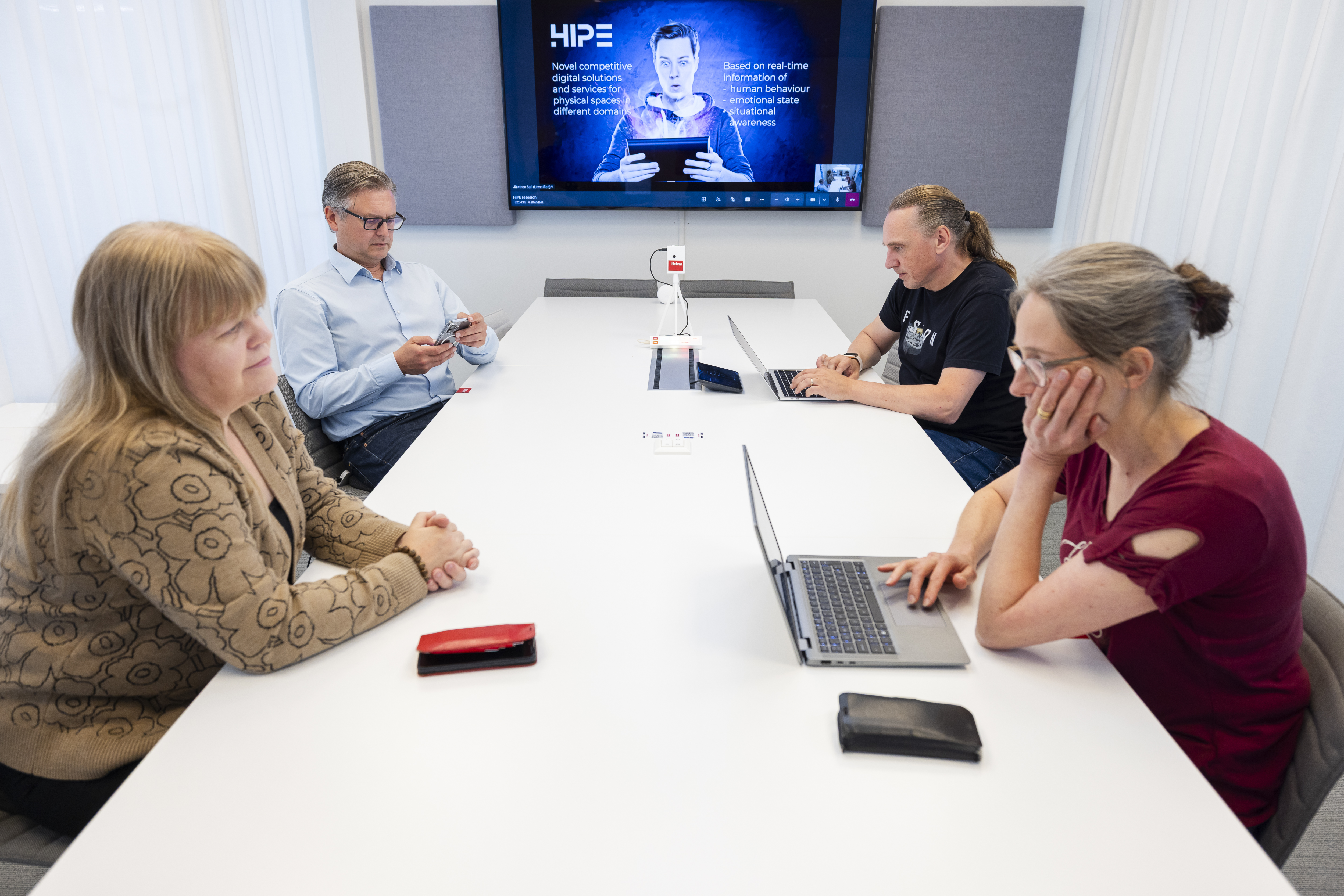
VTT together with partners has developed technology that helps understand human interaction and behaviour in meeting rooms. The smart meeting room analyses group dynamics in real-time and provides feedback while maintaining privacy protection. The goal is smoother meetings, better workplace wellbeing, and purposeful use of workspaces.
Meeting rooms can now provide information that enables the development of meeting practices. In a 3.5-year HIPE project coordinated by VTT Technical Research Centre of Finland, a sensing office environment has been developed and tested. The work environment responds to human interaction and supports smooth workflow.
The Mindful Meetings concept, implemented in collaboration with lighting control system provider Helvar and workspace design and construction company Framery, combines sensor data, artificial intelligence and behavioural analytics. The result is an intelligent meeting space that recognises variations in interaction through human-centric AI and enables both real-time feedback and post-meeting summaries.
"We measure meeting room dynamics: how interaction flows, whether participants maintain attention in the meeting, how active the discussion is and how the environment – light, sound, air quality – affects it. Privacy is maintained because we don't collect data at the individual level but analyse the group as a whole," says Principal Scientist Johannes Peltola from VTT.
"VTT has strong expertise in AI solutions that can interpret and predict human and crowd behaviour in complex and critical situations. By combining multi-sensor data and privacy-preserving analytics, we can detect subtle behavioural patterns – for example, changes in group dynamics on a large scale," Peltola says.
Sensors recognize when devices capture attention
VTT produces video-based analytics including participants' facial direction and whether they are interacting with other participants or with devices (phones, laptops). Chair sensors detect who is speaking, and when and can also provide heart rate variability data when needed.
"Heart rate variability can indicate the extent to which participants are synchronized, that is, how they adapt to each other's interaction. Facial direction, eye contact, and changes in sitting posture reveal how actively present people are in the meeting. This helps to identify moments of passivity or situations where one person dominates the discussion," Peltola explains.
Helvar's technology analyses environmental conditions such as lighting, air quality, and presence data and communicates to meeting participants through light colours how the meeting is progressing.
"The sensing space brings concrete data for organisations to use: what should be changed to make workflow better? At the same time, the solution helps evaluate meeting room utilisation rates and supports decision-making in space planning and time management," says Pasi Takala, Product Manager, Lighting Intelligence, from Helvar.
The sensing space supports organisations in developing meeting practices: by analysing meeting data meetings can be shortened, better prepared, or replaced with informal encounters.
"Meetings and similar human interaction situations are typically the most valuable events in workplaces. However, when functioning poorly, they can also be a major source of frustration and sense of time scarcity. Therefore, it's important to develop ways to make meetings more rewarding both experientially and in terms of results," says Acting Head of R&D Tomi Nokelainen from Framery.
"Expensive expert resources can be wasted in ineffective meetings without real benefit. When we identify these moments early, we can improve both the meaningfulness of workdays and organisational productivity," Peltola summarises.
HIPE project in brief:
HIPE (2021–2025) is a Business Finland-funded Co-Innovation project involving VTT, Teleste, Helvar, ISKU, Framery, Ambientia, and the University of Lapland. The project explores sensing technologies and AI analytics for creating emotion-aware services in physical environments. A key focus is on regulatory frameworks and ethical use of AI.


Continue reading
Service:
Cognitive state estimation solutions
White paper:
Through the Valley of Death – How can Finland grow?
Share