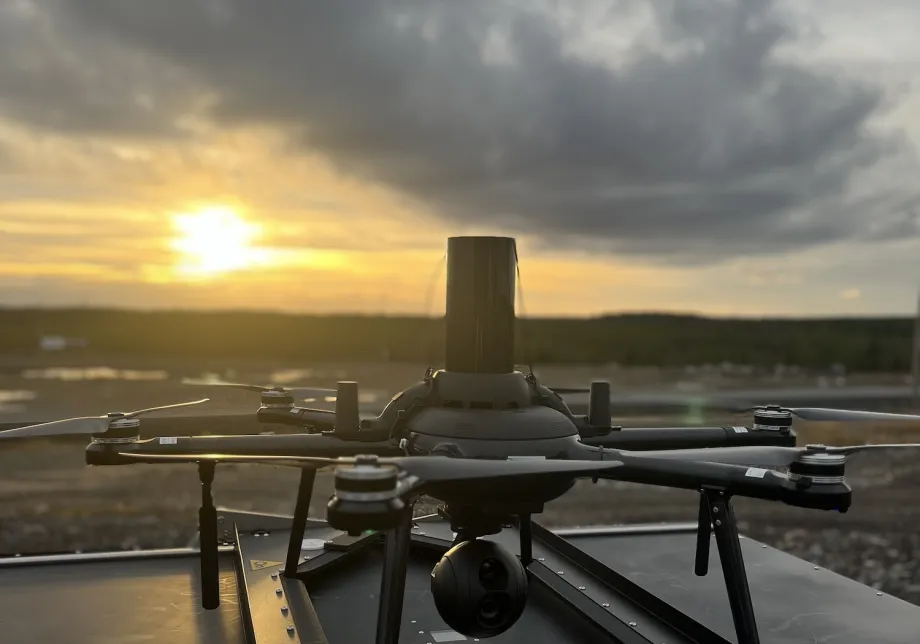
VTT Technical Research Centre operates a uniquely versatile Drone Test Centre in Northern Finland, defined by its extensive flight area, varied terrain, and diverse climate conditions. Together with VTT’s experts, the site, over twice the size of Greater London, offers the possibility to test and develop the functionalities, performance, and Arctic capabilities of drones and drone swarms beyond visual line of sight – on land, water, and in the air. The vast flight zone enables safe testing, accelerates the development of new technologies, and advances new business opportunities.
Helsinki, Finland (April 15, 2026) The commercial use of drones is on the rise, with use cases in the industrial sector, agriculture and precision farming, construction, healthcare, logistics, and rescue and surveillance operations. Located within the vicinity of the city of Oulu in Northern Finland, VTT Technical Research Centre’s test site provides access to more than 3,500 km² of designated Nordic test airspace over diverse terrain ranging from forests and fields to bodies of water and swamps – challenging the drones being tested there with the full breadth of Arctic operating conditions.
The diverse environment and the varying, and potentially extreme, weather conditions of the four seasons enable testing of drones designed to operate on land, underwater, and in the air, supporting the development of new technologies and real-world use cases in both the civilian and defense sectors. Companies can utilise the possibilities the area offers in collaboration with VTT.
“Drone services are on the rise as unmanned aircraft are ideal for improving the efficiency of, for example, logistics, surveying, and monitoring operations. The industry is developing quickly, intensifying the need for diverse test sites where drone functionality, sensors, safety, and airspace management solutions can be tested in real-world conditions. Test sites are crucial for the development and deployment of this new technology, ensuring its reliability and enabling new drone businesses. We support the product development of our customers with versatile technology expertise from sensors to power sources and material choices,” says Timo Lind, Principal Scientist and Chief Drone Pilot at VTT.
150-kilometre test corridor for long-distance drone flights
The test site has been developed and expanded over several years. The newest addition is a test corridor stretching 150 kilometres long and 20 kilometres wide, increasing the area’s size to over twice that of Greater London.
The long test corridor enables drones to fly beyond visual line of sight over long distances across varied terrain and weather conditions, which is critical for assessing their performance. This capability is particularly important as new aviation solutions are developed for applications outside urban areas.
“The need for drone test sites is growing sharply in Europe. Most countries have a test site of some kind, but due to congested airspace, dense populations, and tight regulations, only a few countries can offer sufficiently large and versatile areas. That makes VTT’s site stand out,” comments Lind.
The site is in use during all seasons, with thousands of flights taking place annually.
“Winter in particular offers conditions that cannot be fully simulated in a lab. The cold, humidity, and ice that accumulate on the surfaces of devices reveal the weaknesses in systems, such as the performance of batteries and electronics,” says Lind.
Test site supports the development of swarm technologies and multi-platform systems
The test site also offers a unique setting for the testing of drone swarms. Dozens of drones can be flown in the area simultaneously, which is necessary for real-world operations.
The site also supports testing multi-platform autonomous systems (UxV) by combining drones with land- and water-based devices into a cohesive, coordinated unit. This creates new opportunities for operations conducted on the coast or around other bodies of water, where drones offer a quick situational picture, devices moving on land transport equipment, and devices operating in the water expand the scope of operations.
Aiming for more comprehensive and critical testing capabilities
The test site is continuously being developed to support various applications and new system requirements. The newest investment in the area is a primary radar used to locate drones in varying conditions. The results are used to develop security and the situational picture. Investments will be continued in the coming years. The development of the area also supports the needs of the defense industry.
“In the future, technologies will be tested in the area in even more demanding conditions to ensure the functionality of devices and systems in critical conditions. Test operations are also expanding to heavier aircraft, long-range drones, and high-altitude systems,” says Jussi Kangasoja, UAS Specialist and Senior Scientist at VTT.
The addition of these systems makes the area even more versatile and a strategically significant test site in Europe.
Technical features of the site:
- Designated airspace: Over 3,500 km²
- Highest flight altitude: 2,200 ft; 9,000 ft from April 2026 onwards
- UAS capabilities:
- BVLOS: Flying beyond visual line of sight is allowed
- MTOW (maximum take-off weight): 150 kg
- Payload drop: Airborne object drops are allowed
- Swarm flights: Supported
- Fiber-optic control (C2): Supported
- Airspace classification: Permanent danger zone
- Coordination structure: Multi-operator coordination method in use
- Connectivity: 5G coverage and air permit available through local operators Elisa, Telia and DNA
Meet our experts

Timo Lind is VTT’s Chief Pilot and a leading expert in operational drone flight testing and aviation-grade safety practices for unmanned systems. He is responsible for VTT’s flight operations, including serving as pilot-in-command and developing safe, reliable procedures for testing drones and drone swarms in demanding real-world conditions. With an engineering background and a career spanning multiple major technology environments from Nokia to Microsoft, Lind brings a strong systems-level mindset to the quickly evolving drone sector.
At VTT, Lind supports both civilian and dual-use drone research, helping to integrate new payloads, platforms, and technologies into operational testing, from performance validation and measuring device development to Arctic resilience and flight reliability in cold climates.
“Drones are becoming safer and more autonomous every year. The goal is reliable flight in all conditions, and systems that can manage faults and recover intelligently.”

Jussi Kangasoja is an operational drone pilot at VTT with extensive hands-on expertise in advanced UAV testing, customer-driven development projects, and real-world flight operations in four-season conditions. With a career founded in telecommunications systems and international technology delivery, he brings a strong operational and commercial understanding to drone testing, helping manufacturers and R&D teams translate prototypes into measurable performance.
Kangasoja works closely with drone manufacturers and industrial partners to plan and execute safe, structured testing programs that support product development, including payload validation, connectivity performance, and sensor-based applications such as imaging and environmental monitoring. At VTT’s drone testing environment, he plays a key role in enabling controlled beyond-visual-line-of-sight development work, supported by mobile testing infrastructure and a safety and risk assessment approach.
“A drone is a platform, and the real value comes from what it can carry, measure, and enable safely in real operational environments.”
Continue reading
Service:
Air mobility and drone systems
Share