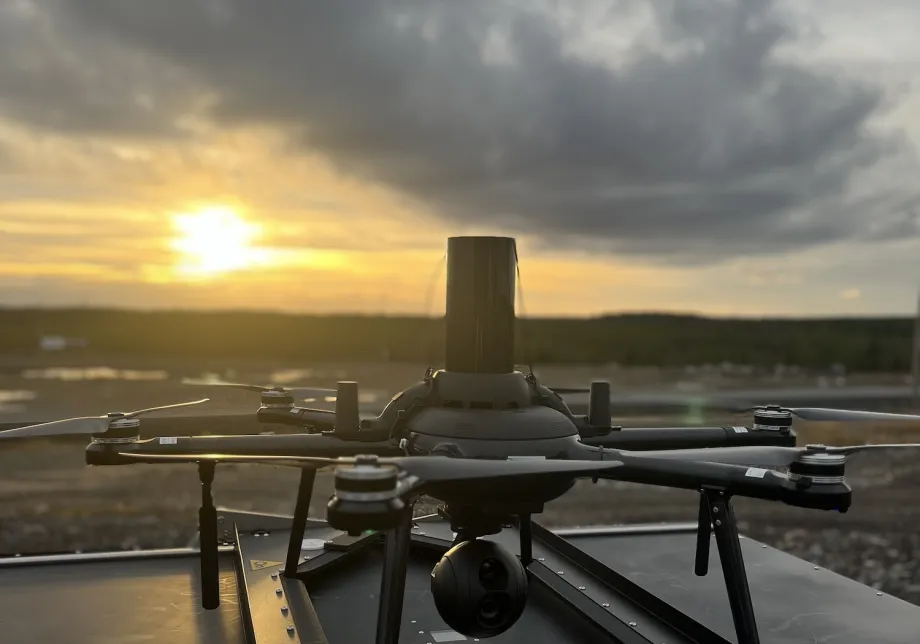
In Ukraine and around the Persian Gulf, the effective use of attack drones has demonstrated why detecting and countering them has become critical for modern security. The challenges presented by drones, or UASs, unmanned aerial systems, are unique. Their rapid evolution makes countering them ever harder. VTT is actively developing cost-efficient, scalable counter-UAS solutions based on sensor and telecommunications technology.
Recent incidents, even in Finland, have highlighted that offensive drones can appear unexpectedly far beyond any military battlefields, raising serious security concerns. Drones can easily remain undetected. Typical air surveillance radars are designed to spot and track aeroplanes higher in the airspace, not to detect agile and stealthy targets flying just above treetops.
For a country as large as Finland, the sheer scale of counter-UAS systems is a complicated challenge. Surveillance only along long land and sea borders is not enough. Capabilities are also needed deeper inside the national territory in case border surveillance is bypassed, at least around critical infrastructure.
“Various types of sensors are essential for UAS detection. However, due to the limited range of a single sensor, Finland would need hundreds of sensors to build observation capability only along the land border. Additionally, the sensors must be relatively inexpensive, not a million euros each,” says VTT’s director Tauno Vähä-Heikkilä, in charge of Strategic Partnerships.
In a conflict situation, the attacker may also aim to oversaturate air defences through launching drones in extremely high numbers, many of which can be decoys. The defender then struggles to spot the real threats quickly.
Sensor systems under intensive development
Ukraine’s experience highlights the need for dense sensor networks first to detect and classify targets, then to activate countermeasures. The key is utilising a combination called integrated sensing and communication to make sense of what is going on. For example, sensors may even detect the electromagnetic radiation of drone motors.
“Effective counter-UAS requires sensor packages and so-called sensor data fusion. The sensor package can include microphones or acoustic sensors, optical and night-vision cameras, radars, radio units and more. AI-based sensor data fusion is necessary to infer information from multiple sensors and to detect objects and changes in their behaviour automatically. We must enable as much real-time decision-making as possible,” says Vähä-Heikkilä.
Among solutions under intensive development is repurposing civilian technologies used in everyday telecommunications. 5G and especially coming 6G systems provide a lot for counter-UAS solutions with its multifunctional and software-defined radio. The communication network can be used to detect and classify drones, and it is possible to modify the radio units to function like a radar.
“Multifunctional radios also enable using the same unit for communications and accurate signal intelligence, which reveals important details of the target and helps to understand what is happening. For instance, drones can be located through scanning their control communications. The same radio system can even work as a signal jamming transmitter,” tells Vähä-Heikkilä.
Of course, the developers of both defensive and offensive drones want resilience to prevent detection and jamming to complete intended missions. Standardized radio frequencies are avoided because they are well known and thus easy to disrupt. Non-standard frequencies are preferred and they can be changed frequently. In today’s frontlines, lots of drones are controlled with fixed fibre cable, making them completely immune to radio jamming.
Defensive drone swarms for 24/7 airspace monitoring
Autonomous drone swarming technology is becoming a key area of development, both in defensive and offensive operations. A swarm can consist of multiple automated drones operating together under the supervision of a single human operator. Some drones within the swarm may focus on observation and target identification, while others are tasked with neutralising threats.
“In peacetime, swarms could optimise surveillance operations autonomously. Drones may maintain continuous area coverage around the clock and organise their own recharging cycles. Human operators would remain responsible only for the most critical decisions, but autonomous systems could manage routine operations within predefined limits and thresholds”, Tauno Vähä-Heikkilä explains.
During war, autonomous swarms and electromagnetic signals can be used to saturate, jam and paralyze enemy attack systems. To protect the swarm, it is critical to use secure drone-to-drone and drone-to-earth communications.
Multi domain operations, i.e., high interoperability with other systems is essential in counter-UAS solutions. Defensive drones could be combined with land and sea drones that take action to counter the intruder. In some cases, connections from space-based systems are also required.
Speed from consumer technology and the new defence approach
The rapid technological evolution increases the challenges for counter-UAS development. Solutions implemented today could become obsolete tomorrow.
“Staying on top of the evolution requires applying a so-called new defence approach. This means that counter-UAS solutions must evolve at a pace closer to consumer technology cycles instead of traditional defence procurement timelines.”
Counter-UAS solutions are intensively developed in Finland in cooperation between the Finnish defence forces, VTT and several companies. As a founder member of the Digital Defence Ecosystem, VTT has broad know-how in drone operation technologies and the multi-layered approach in development aims to develop cost-efficient, scalable and quickly adaptable technological solutions that are fast to deliver.
VTT provides, for instance, expertise in mobile network radio signal sensing, advanced imaging solutions, radiometers and radars, sensor data fusion combined with AI/ML algorithms and data analytics for behavioural analysis and automated decision-making. VTT also operates infrastructure and facilities for drone field testing, including swarm operations.
“We can help in developing ways to deter an attack drone swarm by providing counter-swarming, true autonomy and intelligence of the enemy behaviour. We can provide advanced sensor data analytics and models to anticipate and plan accordingly,” says Tauno Vähä-Heikkilä.
Continue reading
Service:
Air mobility and drone systems
Share


Tauno Vähä-Heikkilä