
“Finland already has strong scientific expertise in quantum technologies. What is still needed is determined R&D, piloting and innovation to accelerate commercialisation,” says Jani Kivioja, who has been appointed Vice President of VTT’s Quantum Technologies research area from 1 November 2026. Kivioja brings experience in both quantum technology research and corporate research and technology leadership.
Jani Kivioja, DSc (Tech), is an experienced research and technology leader specialising in quantum and nanotechnology. He began his career at VTT as a researcher in micro- and nanoelectronics after completing his doctorate on superconducting quantum circuits at the Low Temperature Laboratory of Helsinki University of Technology (now part of Aalto University). He later held leadership positions at Nokia and Picosun, part of Applied Materials. In his new role, he will draw on this experience to bridge the gap between research and technology-driven business.
“Alongside commercialisation, quantum technologies require strong, long-term research because the field is highly research-intensive. VTT will continue to create science-based innovations and turn them into commercial breakthroughs. As Vice President of the research area, Jani Kivioja will drive this work forward with our researchers, partners and customers,” says Erja Turunen, Executive Vice President of VTT’s Digital Systems business area.
Quantum computers are the best-known application in the field
“Quantum computers are attracting growing interest in Finland and worldwide, while the rapid development of artificial intelligence is giving quantum computing further momentum. Using a quantum computer no longer requires an in-depth understanding of the underlying hardware physics, and many technical challenges once considered difficult have already been overcome. Progress is likely to remain rapid, although significant technical challenges remain,” Kivioja says.
The first major applications of quantum computing are difficult to predict. However, Kivioja believes that molecular-level modelling for materials and drug development is likely to be among the earliest.
Beyond quantum computers, quantum phenomena are also used in sensors, measurement and communications. Quantum-physics-based solutions have long been applied in fields such as data encryption, and quantum physics is already an essential part of the operation of many conventional devices, including memory chips.
“Technological advances also affect information security, as quantum computers may one day be able to break current encryption methods. If information sent today must remain confidential for years to come, its protection needs to be addressed now. We need to transition to quantum-safe solutions before the threat becomes a reality,” Kivioja points out.
Finland’s strength lies in long-standing expertise
Finland’s strength in quantum technologies rests on high-quality research, long-standing expertise in low-temperature technology and microelectronics, advanced manufacturing infrastructure, and a strong business and research ecosystem.
Looking back at Finland’s research history, Kivioja highlights the pioneering low-temperature technology research conducted decades ago at the Low Temperature Laboratory of Helsinki University of Technology, as well as the development of superconducting tunnel junctions, known as Josephson junctions, and SQUID sensors.
“Manufacturing methods have advanced rapidly, and their precision is now in an entirely different league from before. VTT’s investments in new manufacturing methods are opening new opportunities to develop sensors and other quantum technologies, while laying a strong foundation for the next breakthroughs,” Kivioja says.
“Finland has strong expertise, high-quality infrastructure and promising growth companies. We must have the patience to turn research results into international business so that the value they create remains in Finland. The greatest breakthroughs are still ahead of us, which is precisely why this is such an exciting time to help shape the future of quantum technology,” Kivioja reflects.
Continue reading
Service:
Quantum computing
White paper:
Through the Valley of Death – How can Finland grow?
Share


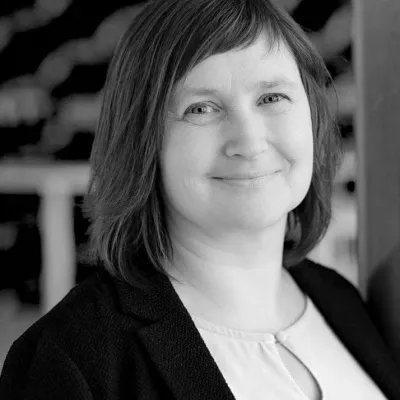
Erja Turunen


